
Imagine pulling your golden, tempting galette des rois from the oven, only to discover a runny frangipane spilling out and open edges. It’s a frustrating scene, but one that can be easily avoided with a simple step that many overlook.
Why does the galette open during baking
Puff pastry can be quite finicky. When freshly handled, its gluten network is very elastic.
As the pastry encounters heat, it contracts. If the seams aren’t properly stabilized, the tension pulls at the edges, causing the frangipane to escape.
Occasionally, unintentional errors contribute to this, such as too much filling, an overly airy cream, or applying the egg wash to the edges. All of these increase the risk of leakage.
The overlooked step: chilling in the fridge
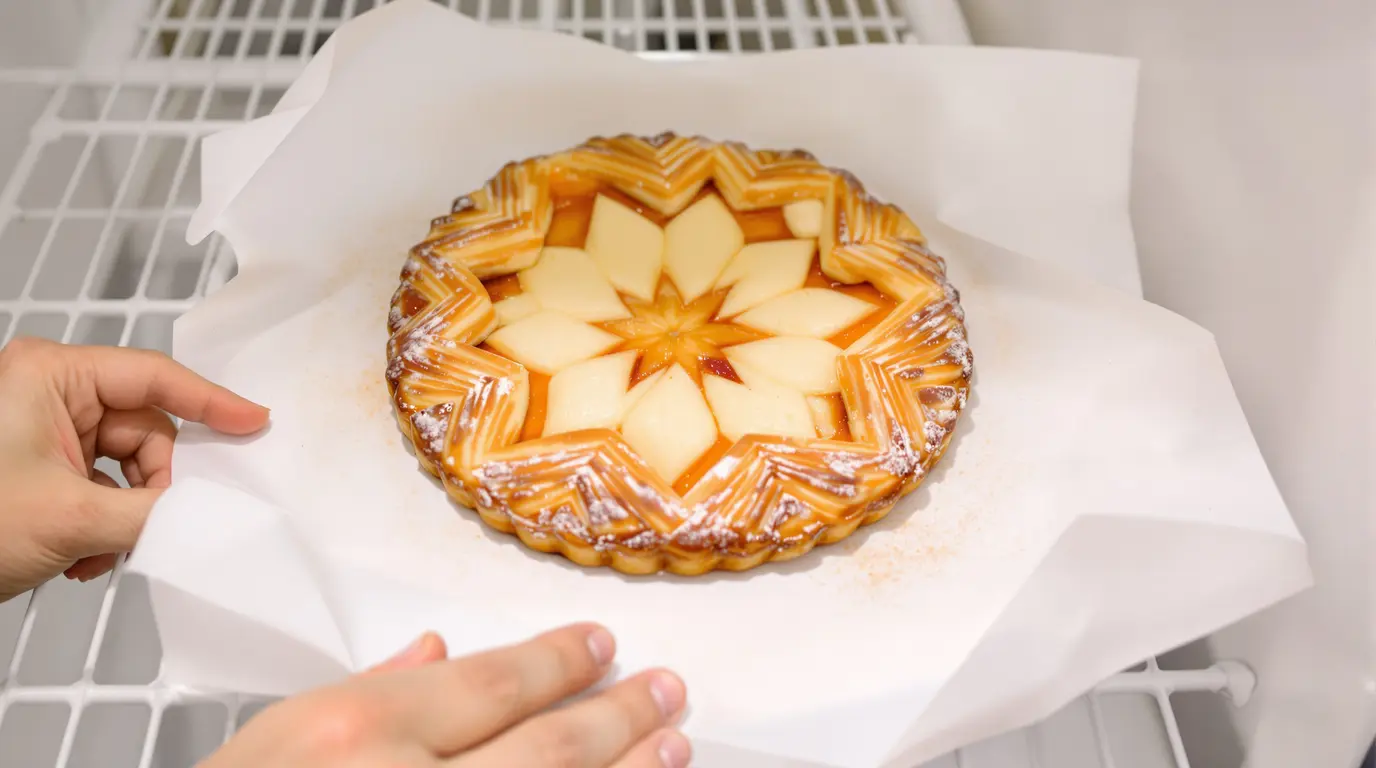
The solution is simple: give it a good chill. After assembling and applying the egg wash, let your galette rest in the refrigerator for at least two hours.
Even better, prepare the galette a day ahead and wrap it tightly in plastic wrap overnight. Cooling helps relax the gluten, and the filling firms up slightly.
This chilling time allows the seams to set. When the pastry bakes, it is less likely to stretch at the edges.
Assembly and key techniques for a leak-proof galette
Assembling the galette requires a few simple yet effective precautions. Start by gently piercing the bottom layer to minimize air pockets.
Spread the frangipane from the center outwards, leaving about a 2 cm border free of filling. Dampen this border slightly with water before placing the top layer over it.
Use your fingers to seal the edges without crushing the layers, as using a knife or fork can compress the perimeter and prevent the pastry from rising properly.
Create a small vent in the center and add a few discreet holes to let steam escape. Finally, apply the egg wash carefully, avoiding the edges.
Quick frangipane recipe (for a 26 cm galette)
Ingredients:
- 100 g soft unsalted butter
- 100 g powdered sugar
- 100 g almond flour
- 2 whole eggs
- 10 g flour (1 tablespoon)
- 1 tablespoon rum or almond extract (optional)
Preparation:
- Beat the butter and sugar together until creamy.
- Incorporate the almond flour, then add the eggs one at a time.
- Add the flour and any flavoring, mixing just enough to combine. Avoid vigorous whisking to keep air out.
- Chill if you’re assembling the galette right away.
Checklist before baking
- The galette has rested in the fridge for at least 2 hours.
- The frangipane is positioned 2 cm from the edge, without bulging.
- The edges are firmly sealed with no egg wash on the border.
- The bottom disk is lightly pierced, with no punctured holes through the pastry.
- A center vent and a few small holes are established for steam release.
- The oven is preheated to 180 °C and ready for 40 to 45 minutes of baking.
Additional tips to prevent leaks
If you are concerned about leaks, place the galette on a sheet of parchment paper on a baking tray. A second tray underneath will catch any spills, protecting your oven.
If the frangipane seems too soft, add an extra tablespoon of flour to thicken it slightly. Be careful not to overload the galette; 300 to 350 g of frangipane is sufficient for a 26 cm dish.
For a beautiful finish, take the galette out 10 to 15 minutes before baking, apply a final egg wash, create the design, and then return it to the oven. This small final touch enhances the coloration.
By following these suggestions, you can nearly eliminate the risk of finding frangipane on the baking sheet. A little patience in the fridge makes all the difference. This year, you just might keep your crown intact.