
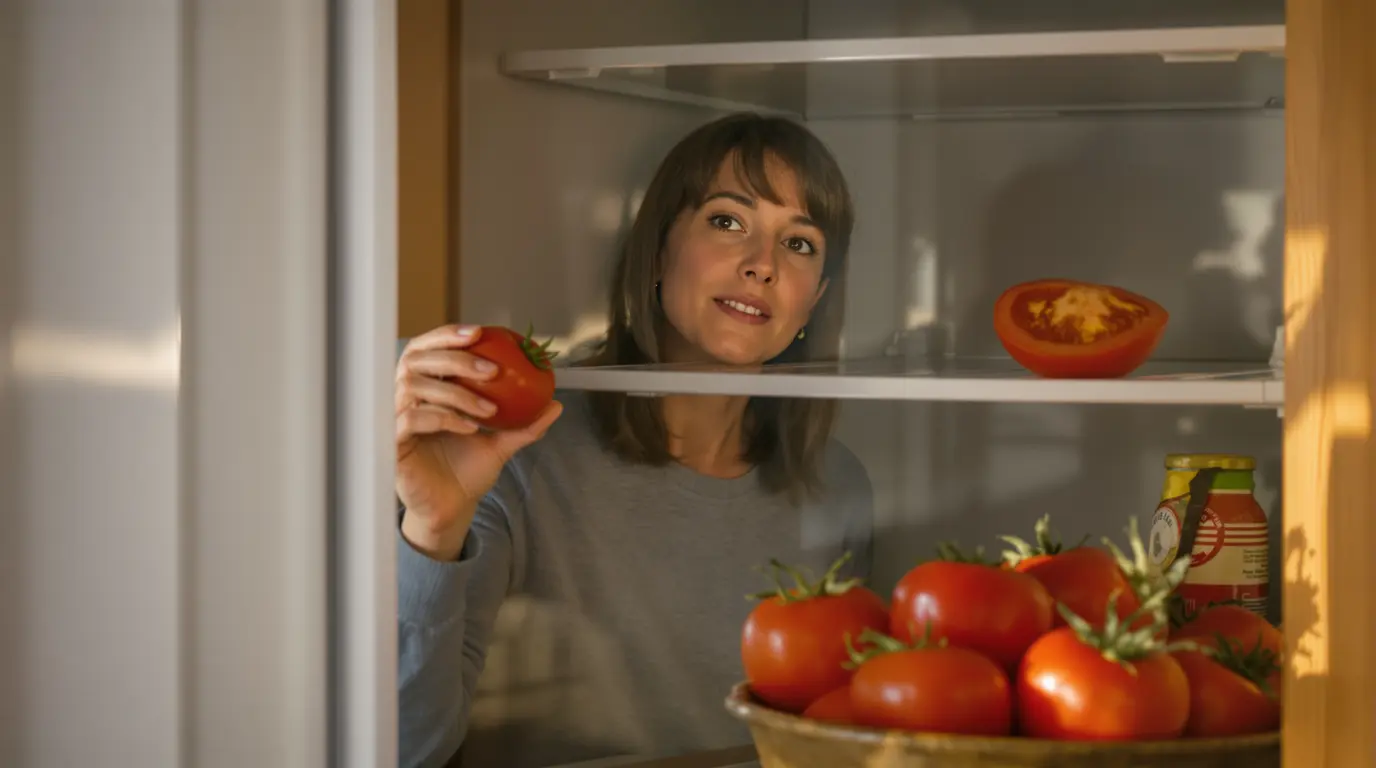
You may think that refrigerating your tomatoes is a smart move, but in reality, it often leads to a loss of what makes them so enjoyable. Their flavor can weaken, their texture may become less appealing, and their scent could be nearly absent. The issue often lies not with the tomatoes themselves, but with where you choose to store them.
The cold damages more than we think
Tomatoes are technically fruits, though they are commonly treated as vegetables. Like many fruits, they do not appreciate the cold. When temperatures dip below 12 °C, a portion of their aromatic compounds starts to diminish. In the refrigerator, this effect intensifies.
This leads to a rapid decline in tomato flavor. They become less juicy and may develop a mealy texture. You may have noticed this when biting into a tomato that feels a bit hard or even sad. It’s not just in your mind; the cold is indeed altering its texture.
Why the fridge also changes nutritional quality
Many of us believe that refrigerating everything preserves its freshness. However, with tomatoes, it’s the opposite. Low temperatures slow down the production of lycopene, the well-known red pigment, and also decrease the effectiveness of certain antioxidants.
Of course, tomatoes remain edible and won’t spoil immediately. However, their nutritional benefits take a small hit. If you want to maximize their advantages, the fridge is not your best friend.
The best place to store your tomatoes
Experts recommend keeping tomatoes in a cool room, ideally between 15 to 18 °C. A pantry, cellar, or a shaded corner of your kitchen works wonderfully. A fruit bowl on the counter is also appropriate, as long as the room isn’t too warm.
The key is to keep them at room temperature. Avoid placing them near a sunny window or next to the oven. A stable, dry, and well-ventilated space is most effective. It’s a simple approach but highly effective.
Should you take them out of the fridge before eating
Many people instinctively take tomatoes out of the fridge 30 minutes before serving. While this is better than eating them cold, it’s still not enough to fully recover their flavor.
Some aromas may return as they warm up, but not all. Some are lost for good. This is why it is best to avoid putting them in the fridge at all, unless absolutely necessary.
When the fridge can still be useful
There is, however, an exception. If your tomatoes are quite ripe and you cannot eat them immediately, the fridge can help slow down their decay. In such cases, it’s better to refrigerate them than let them spoil on the countertop.
However, this should not become a habit. As soon as possible, take them out and consume them quickly. The flavor will always be better in well-stored tomatoes kept at a mild temperature.
Good practices for keeping savory tomatoes
Following a few simple practices can make a significant difference. These habits take little time and can save you from disappointment when it’s time to enjoy your tomatoes. Here are the most effective tips:
- Keep tomatoes at room temperature, in a cool, dry place.
- Avoid direct sunlight, which speeds up aging.
- Don’t stack them too high, to prevent bruising.
- Eat them quickly, ideally within three or four days.
- Wash them just before eating, not too early.
Why the best tomatoes are eaten quickly
A good tomato doesn’t wait around. The longer you keep it, the more it loses its aroma and texture. It’s frustrating, but that’s just how it is. A fully ripe tomato should be enjoyed swiftly, almost thoughtlessly.
Jean-Philippe Briand, a producer in Provence, emphasizes this point clearly. Ideally, they should be consumed within three or four days. He is correct. A tomato bought in the morning and eaten that evening tastes entirely different than one forgotten in the fridge for a week.
A small change that makes a big difference on the plate
This advice may seem simple, perhaps overly so. Yet, it can genuinely transform your salads, toasts, and homemade sauces. A well-stored tomato smells better, tastes stronger, and brings immediate pleasure to the table.
So yes, you can reserve the fridge for other foods. But for tomatoes, it’s better to give them a proper place in a suitable environment. This small detail can often mean the difference between a bland tomato and a flavorful one. And honestly, it’s worth giving it a try!