
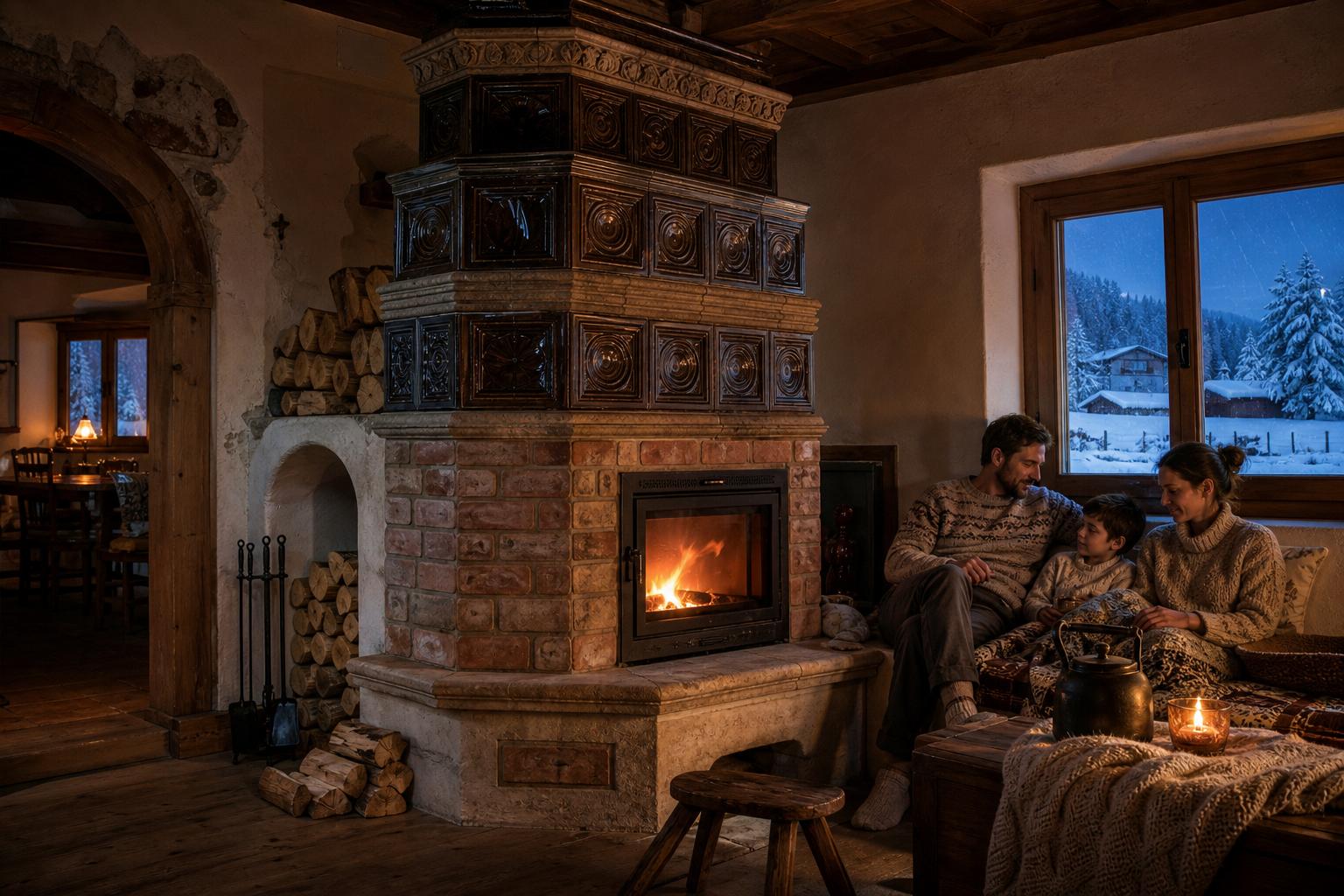
Introduction – On a chilly January morning in an old house, the electric radiator is working hard, yet the living room feels cold. Meanwhile, a few kilometers away, a family has reignited their masonry stove built against a supporting wall. After a couple of short flames, they enjoy a gentle warmth that lasts nearly all day. This old concept from Central and Northern Europe, once dismissed as rustic, is now regaining attention. With climbing utility bills and strained energy systems, the focus has shifted back to simplicity.
We all have that moment of hesitation when looking at the meter, checking the weather, or anticipating the next bill. In alpine villages and certain renovated homes in Alsace, the masonry stove is finding an intriguing place: not a trendy gadget or a nostalgic relic, but a heavy, silent, and undeniably practical object. It heats slowly, quietly, and continues to radiate warmth even after the fire has gone out. This aspect piques curiosity.
The masonry stove: an old European response to the cold
At first glance, a masonry stove may seem unremarkable: a large block of bricks, stone, or tiles, occasionally adorned with decorative tiles. However, behind its almost stationary appearance lies a formidable logic: it captures heat from a hot fire and stores it within hundreds of kilograms of material. Instead of experiencing a blast of hot air followed by a chill, the room benefits from a steady warmth that resembles the sun’s rays warming a stone wall.
Predecessors of the tiled stove appeared in Germanic and alpine regions as early as the late Middle Ages before spreading across parts of Northern and Eastern Europe. In Sweden, Finland, Austria, and Eastern France, these devices evolved over time to address a fundamental reality: winters can be long, and wood is not an infinite resource. A well-managed fire could keep a home warm for hours, sometimes even until the next day.
The principle behind it is less mysterious than it seems. The fire burns at high temperatures within a combustion chamber designed for complete combustion, with the smoke traveling through a long internal path before reaching the flue. As it moves, it transfers its energy to the surrounding materials. This is not a dramatic heat; it is a steady warmth that settles in. In an era accustomed to instant gratification at the push of a button, this slow method may appear outdated. However, it becomes an advantage when every kilowatt-hour counts.
Why this simplicity can become strategic again
The first step is to assess your living space before selecting a heating option. A masonry stove is not a magic wand placed in the middle of a poorly insulated room; it performs best in a compact, well-renovated home centered around a communal living area. Placement is crucial, for the mass should be able to disperse heat without being blocked by doors. A qualified professional can evaluate the flue, weight loads, and the household’s specific needs.
A common misconception is that one must tend the fire all day, as with an old cast iron stove. Often, it is the opposite: a masonry stove thrives on short, intense, and well-prepared fires fueled by truly dry wood. Let’s be honest: not everyone manages this daily with perfect discipline. However, preparing fuel ahead of time, using a moisture meter, and learning the right rhythm can prevent smoke, blackened glass, and many disappointments.
This technology is not a catch-all solution, especially in poorly configured apartments or homes. Still, it emphasizes a crucial idea: consuming less energy should be the first step before looking to produce more. As artisans often summarize:
“The best fuel is the one you do not need to burn.”
- A fire lasting one to three hours can provide extended warmth.
- The thermal mass reduces drastic temperature fluctuations.
- Wood should be dry, preferably local, and burned in an appropriate device.
A slow warmth that changes our habits
The return of the masonry stove is part of a larger narrative about wood heating. It challenges our instinct to demand immediate comfort: warmer, faster, stronger. In a family living room or open kitchen, radiant heat subtly alters daily life. People tend to stay in the same room longer, close a door, and prepare for the evening fire in advance. These are small actions, not a surface-level revolution.
It is important to remain realistic: installing such a system represents a significant investment, often costing several thousand euros plus additional work, flue installation, and sometimes floor reinforcement. It also requires space and a responsible supply of fuel. Yet, when well designed and maintained, it can last for decades. In a time when some devices become obsolete before even paying for themselves, this durability holds weight in the decision-making process.
The energy crisis has highlighted a truth that was perhaps too quickly forgotten: sophistication does not always equate to safety. A masonry stove relies neither on an app nor on updates or subscriptions. It requires human expertise, sustainable materials, and a bit of foresight. This ancient European invention won’t erase energy-related concerns, but it offers a compelling current solution: creating comfort with less dependence, and rediscovering enduring solutions.
| Key point | Detail | Added value for the reader |
|---|---|---|
| Stored heat | Stone, brick, or tile accumulates the energy from a fire. | More stable temperatures and gentle comfort. |
| Well-prepared wood | Dry fuel promotes cleaner and more efficient combustion. | Less smoke, less waste, and an easier-to-maintain fireplace. |
| Custom project | The weight, flue, and layout of the home must be considered. | Avoid a costly installation that is poorly suited. |
FAQ :
- Does a masonry stove heat an entire house? It can cover a significant portion of heating needs in a well-insulated and well-configured home. In larger houses, it often serves as the main heat source, supplemented in distant rooms.
- How does it differ from a traditional wood stove? A traditional stove primarily radiates heat during combustion. The masonry stove stores a large amount of heat and releases it slowly after the fire goes out.
- Do you need to burn a lot of wood? No, its efficiency lies in effective short burns with dry wood. The amount needed varies based on space, insulation, weather, and the chosen model.
- Can you install a masonry stove in an old house? Yes, provided there is a thorough assessment of the floor, flue, ventilation, and placement. Expert advice is essential.
- Is it an ecological solution? It can be if a high-performance device is used, with sustainably sourced wood and controlled combustion. Reducing heating needs remains the first lever.