
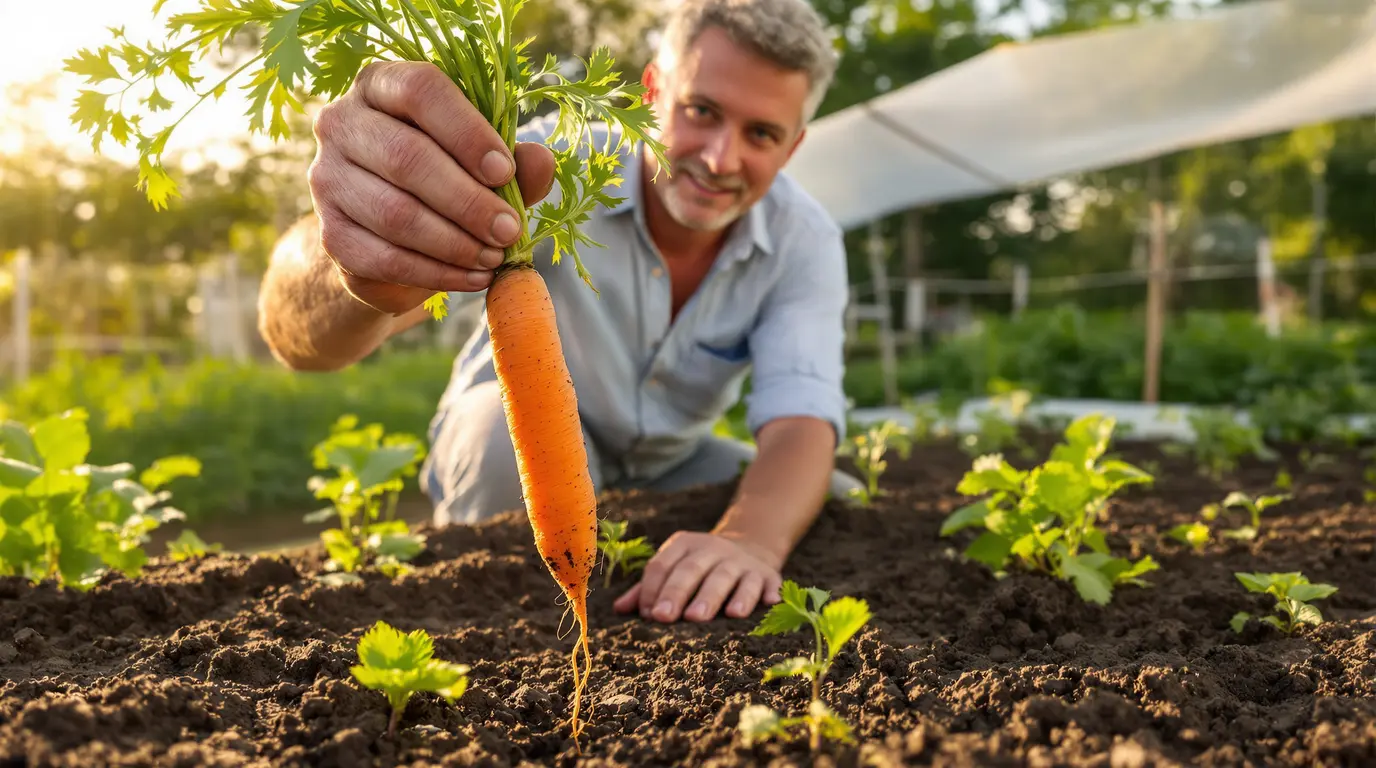
Many gardeners see July as a concluding point in the growing season. When it comes to carrots, they often think it’s too late, too hot, or too dry. However, this is exactly when professional growers can shine. Their approach is straightforward, requiring just precision and a touch of patience.
Why sowing carrots in July is not a bad idea
In the summer, vegetable gardens can feel overwhelming. The soil hardens quickly, water evaporates, and seedlings germinate unevenly. While this is true, carrots thrive as the heat begins to wane.
Sown in July, they benefit from the warm soil for initial growth, then flourish as temperatures drop at night. The end result is a lovely autumn harvest that often turns out to be more tender and sweeter than expected.
It’s not the timing that matters most. It’s how you sow them, and that’s where the growers’ technique makes a world of difference.
Preparing a fine and deep soil
A successful carrot starts beneath the surface, well before the seeds are planted. If the soil is heavy, stony, or compacted, the roots can twist, split, or grow deformed.
Professional gardeners work the soil to a depth of about 12 to 14 inches. They don’t necessarily till the entire area, but loosen it, making it pliable. A broad fork is often perfect for this task.
Next, they remove stones, hard clumps, and anything that could obstruct the roots. If the soil is very compact, a raised bed can be beneficial. The goal is simple: to provide a cozy bed for the carrots.
Avoid at all costs: fresh manure just before sowing. It can lead to deformities. Mature compost, incorporated several weeks ahead, is a much better choice.
The precise method of sowing
When it comes to carrots, every detail counts. If sown too deeply, the seeds struggle to germinate. If planted too closely, the young plants compete with one another. Too much soil on top can lead to uneven germination.
Growers create a shallow trench, about 1 centimeter deep, with rows spaced 10 to 12 inches apart. Seeds are sown very sparingly to avoid overcrowding. A tidy row is preferable to a heap of misplaced seeds.
A clever trick is to mix in a few radish seeds with the carrots. Radishes grow quickly and indicate the row, making it easier to identify the planting line without having to wait too long.
After sowing, cover with a thin layer of soil, then gently flatten it with the back of a rake. The aim is not to crush but to ensure the seeds come into contact with moisture.
Keeping moisture without soaking the seeds
In July, the soil surface dries out rapidly. This is often where success falters. A day of hot wind can create a hard crust, preventing young shoots from emerging.
The growers’ method relies on gentle watering. Avoid strong jets or heavy rain that can disturb the soil. Instead, use a fine mist, regularly and softly. It is essential to keep the surface moist until germination.
In the first few days, a lightweight cover or board placed above the seedlings can help maintain moisture. Be sure to remove it as soon as you see the first sprouts. Otherwise, the seedlings could lack light.
Once the carrots are established, watering can shift to a deeper but less frequent practice. Typically, 2 to 3 centimeters of water per week is sufficient, depending on the heat and soil type.
Thinning without disturbing the young roots
This is a step many gardeners postpone, yet it is crucial. If carrots are too close together, they will compete for space and become thin, weak, or twisted.
As soon as the seedlings have two true leaves, it’s time to thin them out. Growers often keep one plant every 3 centimeters and, later, adjust to 6 to 8 centimeters apart depending on the variety.
A smart approach is to use scissors to cut excess seedlings instead of pulling them out. Otherwise, you risk disturbing the nearby roots. This small detail makes a significant difference.
A light mulch can also help after thinning, retaining moisture and reducing heat stress. Once again, consistent watering is better than heavy bursts.
Protecting the crops until harvest
Carrots do not just attract gardeners; they also attract the carrot fly, a stealthy but dangerous pest. This insect identifies crops by the scent of the foliage.
To outsmart them, growers often use insect mesh. They also make sure not to leave cut foliage on the ground and sometimes plant carrots alongside onions or leeks, whose scent can confuse the pests.
Crop rotation is also essential. Avoid planting carrots in the same spot year after year. A rotation period of 3 to 4 years is a good rule to minimize issues.
For July sowings, the variety matters, too. Nantaise and Touchon are ideal for quicker harvests, while Autumn King and Flakke are excellent for later yields.
A simple calendar to remember
| Step | What to do |
|---|---|
| Before sowing | Loosen the soil, remove stones, add mature compost |
| Sowing | Sow at 1 cm depth, in rows spaced 25 to 30 cm apart |
| Germination | Keep the soil moist with light, regular watering |
| Thinning | Leave one plant every 6 to 8 cm |
| Maintenance | Use light mulch and water without excess |
In reality, sowing carrots in July is far from impossible. It requires moving away from the notion of quick fixes. Here, success boils down to soil, water, and patience. It may not be as visually striking as a perfectly manicured garden, but it certainly works better in the earth.
And when you finally pull out a perfectly straight, orange, sweet, and crunchy carrot, everything becomes clear. The garden was not done; it was simply waiting for the right technique.